
Subcategories
A Article Count: 4
B Article Count: 13
C Article Count: 15
D Article Count: 4
E Article Count: 3
F Article Count: 6
G Article Count: 6
H Article Count: 4
I Article Count: 1
J Article Count: 5
K Article Count: 3
L Article Count: 5
M Article Count: 12
N Article Count: 3
O Article Count: 2
P Article Count: 7
R Article Count: 2
S Article Count: 16
T Article Count: 6
W Article Count: 14
Bill Pitt
Guardian obituary
 My former colleague, Bill Pitt, who has died aged 80. Had his fifteen minutes of fame in October 1981 when he became the first Member of Parliament elected under for the SDP-Liberal Alliance, following the Liberal and Social Democrat parties joining in an electoral alliance. Bill had fought the Croydon North West constituency unsuccessfully at the three previous elections and the Liberal leader, David Steel, wanted him to stand aside for Shirley Williams. David did not enlist the key Liberal party committee in this quest and Bill - and the party - took the huff, dug their heels in and insisted on standing, scoring a remarkable success. Bill was rather complacent about holding the seat and did not give it the attention it needed and partly as a result he lost at the general election less than two years later.
Bill was a convivial and popular Liberal party colleague, having joined the party in the 1960s after a few years in the Norwood Young Conservatives. He served on many party committees both regionally and nationally, including at one point editing the internal scandal sheet Radical Bulletin. He polled creditably in Croydon North West in the two general elections of 1974 but lost his deposit at the 1979 contest. He did, however, more than double that Liberal vote at the May 1981 Greater London Council election covering the same area. The Croydon by-election followed close on the heels of Roy Jenkins' contest in Warrington in which, though he did not win, Jenkins polled unexpectedly well. Party managers believed that, though, under the alliance terms, it was the Liberals' "turn" it needed a big name, hence the Shirley Williams idea. The parties' made the best of Bill's subsequent victory pointing out that, if the Alliance could win such an unprepossessing seat without a celebrity candidate such as Williams, it could win anywhere.
After losing his Croydon North West seat Bill fought the Thanet South constituency in 1987 and 1992 but then joined the Labour party stating that he was disillusioned with the Liberal Democrats, as the merged Liberal party and SDP had become, and that he wanted to stop Jonathan Aitken winning the seat again. He unsuccessfully fought local elections for Labour in the Isle of Thanet. Following his retirement from full time employment in 2003, Bill got involved with a number of local voluntary organisations, particularly to do with music and photography. He also became a newsreader for Academy FM Thanet and became a mentor to newer recruits to the radio station's team. He leaves a wife, Janet, and a daughter, Jane.
William Pitt, born 17 July 1937, died 17 November 2017.
Rev Geoff Percival - an appreciation
 Geoff arrived on the local community scene some twenty-five years ago, just before I left Bradford CVS. He was an ideal voluntary organisation officer: intelligent, progressive, determined, comradely, patient - at least on the surface - and he wore a dog collar!
Since that time I got to know Geoff in a wide variety of guises. With Sylvia and Liz we dined together from time to time, swapping information on restaurants to visit, or enjoying leisurely meals in our homes. With Geoff in charge of the cooking there was always at least one, if not many, exotic dishes, usually with some ingredient known only to Geoff.
When we were looking for new partners in the house in the Languedoc, Geoff and Sylvia were obvious recruits and until Geoff became too ill to make the journey he was an enthusiastic user of the house and a knowledgeable taster and - much more - a consumer of the wine of the local Faugères appellation. The conviviality of the meetings of the house co-operative was always enhanced by Geoff's presence.
From time to time Geoff would produce some apparently recondite solution to a problem at the Faugères house. With his technical experience and scientific knowledge it was difficult to argue against some invention that to us innocents seemed completely weird and impractical. One such was a sort of self-condensing air conditioner which didn't need an outlet! We posed every possible question and objection but Geoff was as stubborn as ever. Eventually we suggested that he get on with its manufacture. Nothing ever happened! This was an example of one of Geoff's idiosyncrasies: during the time that he was keen on an idea no obstacle was insuperable, but once he had lost interest no amount of pressure could catalyse him into action. Sometimes it was just when one had got used to some Geoff idea that one discovered that he had abandoned it!
Geoff's computer skills were remarkable. He was very rarely defeated by any problem and on the odd occasion when he couldn't immediately rescue the situation, and after having spent an inordinate amount of time at Waterloo Lodge or wherever, there would be a later flash of inspiration and an immediate 'phone call or visit with an insistent demand to "try clicking this and scrolling to that ...." and it would usually work. He enjoyed equipping me for my missions to exotic places with innovative portable items and often some brand new dial up network that would work "everywhere."
Of course, even though solidly ensconced in front of the screen, lubricated probably too regularly with glasses of a good Faugères red, he would be conducting other rescue missions via his portable. I would only hear his end of the conversation and I would be fascinated by his apparent patience with a colleague whose technical naivety was only too obvious. After some minutes of "try this, try that .... what can you see? .... no, no, no - you've got the wrong screen .... you can't possibly have that visible etc," he would discover that he, or more often she, hadn't even got it connected to the 'phone line! The same conversations would even go on as we drove down the French motorways to the Languedoc.
One thing Geoff wasn't was a businessman. If he had been he would surely have been able to sell his technical skills. At heart the problem was that didn't really want to charge anyone anything! Consequently he fixed his servicing fee far too low and even then rarely got around to sending invoices. Attention to any sort of paper bureaucracy was far less of a priority than all the practical demands on his time. We had to remember when our "sub" was up and then force a cheque on him.
In a sense the Church of England was made for individuals like Geoff. It paid him a basic stipend which gave him great freedom to do "good works" that would never bring an income. He did, of course, give attention to his clerical duties, but his typical generosity to the local Methodists in offering them a home when their church was burnt down, paid dividends in that he had another team to share the formal services, particularly after his church at Windhill became a joint Anglican-Methodist centre of worship. He wasn't always fully attuned to the Methodist preaching "plan." On one occasion as we sat on the terrace at Faugères enjoying chilled white wine in the sunshine, his portable rang. It was the local Methodist secretary - wholly unaware that Geoff was not in the "parish" - wanting to check the hymns for a service at Baildon the day after! It took a number of calls, and some fast footwork, for Geoff to find a replacement preacher.
The same list of willing substitutes must also have been available when I needed immediate assistance on some far distant mission, as he seemed to be able to appear over one's shoulder almost as the 'phone call was still proceeding. "Send me a ticket, and I'll be there," was his constant refrain, and we often recalled with relish producing an illicit CD-ROM of the electoral register in Zambia, with Geoff surrounded by local staff and mountains of scanned paper from which the CD eventually emerged.
I only saw aspects of Geoff's parish life at Windhill from a distance, but his patience with individuals with problems, often men with serious mental illness, was remarkable. He never rejected anyone and continued to work with a number of people, both in the church and in the local community association, who frankly sometimes didn't deserve the care he lavished on them. How he put up with the vandalism and burglaries at the vicarage, I'll never know. And which other vicar would be able to construct a rotating iron frame big enough to cope with a whole sheep for a vicarage barbecue?
Once, after Geoff and Sylvia had moved to Oakenshaw, he was late arriving for a meeting and was giggling away as he got out the car. Apparently, as he was coming down his drive to his car, complete with dog collar, an irate man had accosted him. "It's about our Sharon. What are going to do about it? And you a clergyman." Geoff was, of course, totally baffled and said so. "Don't try and pretend you don't know," responded the man, "I want to know what you're going to do about it." Again, Geoff expressed his complete puzzlement. The man continued, "and you a man of the cloth, carrying on with a young girl like this." Eventually it transpired that "Sharon" was pregnant and that the man at Geoff's address was responsible. Geoff calmed the man down enough to enquire about the origin of the address. It turned out that it was the occupant of the same house number in Bradford Road, but in Cleckheaton not Oakenshaw! Geoff was rather chuffed that he might be thought capable of such "carrying on."
Geoff's technological skills were occasionally used in splendidly curious ways. Once, being in receipt of an e-mail telling him that a former Nigerian government offical want to transfer zillions of pounds to his account, Geoff replied from one of his many untraceable e-mail addresses. After a couple of e-mail exchanges, Geoff agreed to pay the required up front cash in order to have the Nigerian welath unspendable released. Geoff insisted on paying in cash and arranged to meet the Nigerian official at the disembarkment point of the Hull to Rotterdam ferry. Geoff had selected this precise spot as he had discovered that it was possible to receive an online feed from a CCTV camera on the quay. Geoff watched with glee from his home as the Nigerian walked up and down for ages, regularly consulting his watch, as he waited in vain for his "client" to arrive.
Geoff was remarkably well read, particularly on obscure subjects, and it was perhaps fitting that his last contribution, when he was already very ill, to the Notes and Queries column in The Guardian was on the fate of the Akong of Swat!
A great friend and colleague; often infuriating but always lovable; a bon viveur and a great human being, Geoff will be very much missed.
Geoffrey Percival, born 4 May 1946, died 14 August 2009
Denis Pedder
 North Yorkshire and former Leeds Councillor, Denis Pedder, has died in Humanby, North Yorkshire, at the age of 76. He had been suffering from cancer for some time. At the time of his death he was an Independent Councillor on the North Yorkshire County Council, representing the Cayton Division, and until his retirement last year had been a Scarborough District Councillor for the Hertford ward.
Born in October 1927, Councillor Pedder had had a chequered career in politics. He first contested Leeds City Council elections in 1960 as an Independent candidate for the Westfield ward. Thereafter he joined the Liberal party for whom he contested the Stanningley ward unsuccessfully on five occasions, from 1961 to 1965. He was also the unsuccessful Liberal parliamentary candidate for Leeds West in 1964 and 1966 and for Leeds South in February 1974.
His electoral fortunes changed in 1969. Having been the election agent for David Austick's narrow victory for the Liberals at a by-election in the West Hunslet ward in 1968, Denis Pedder then took the same ward in May 1969 with a majority of over 1,000. He held West Hunslet easily in 1972 and then in 1973 he won the combined East and West Hunslet ward for both the City Council and for the short-lived West Yorkshire Metropolitan County Council.
On the Leeds City Council he was the Liberal Group's Chief Whip until he suddenly resigned that office on the day of a City Council meeting. Following the council meeting he was expelled from the Liberal Group whereupon he immediately applied to join the Labour party. Labour, being conscious of Pedder's mercurial and sometimes capricious personality, delayed admitting him to membership and so he withdrew his application. He then contested Hunslet twice unsuccessfully as an independent.
Denis Pedder was educated at secondary school in Lancaster and subsequently at Burnley Technical College and Leeds University. By profession he was a manufacturing chemist and, later, a consultant microbiologist. In the recession of the mid 1970s he lost a number of consultancy contracts and to survive financially he bought an off licence in Beeston, in his electoral ward. On retirement he moved to Hunmanby and immediately began contesting elections there.
Denis Pedder was a fearless advocate of a cause and a remarkable orator whose speeches to a packed concert room on Saturday nights at the West Hunslet Liberal Club greatly helped him to win his seat. He was a difficult colleague but a great individualist who on occasion showed considerable foresight - only some five years after its construction he told the Leeds City Council that the deck-access Hunslet Grange development would be demolished in his lifetime. He was right: it lasted only into the 1980s.
He leaves a wife, Kathleen and two daughters.
Jerry Pearlman MBE
 Jerry Pearlman practised as a solicitor in Leeds for sixty years and was one the best known and most popular lawyers in the city. He was particularly known for his dogged persistence in defending rights of way and in creating better access to the countryside. He played a significant role in the successful lobbying for the Countryside and Rights of Way Act 2000 which was the key legislation in creating access and the "right to roam." He and his wife, Bernice, were themselves great walkers and had a ready base with a cottage in the hamlet of Stalling Busk in Raydale, North Yorkshire. As a consequence of his notoriety as an environmental lawyer he ended up acting for campaigners he described as eccentric zealots with the potential to change the law. Three of these he described in his recent book Tales from an Environmental and Tribal Lawyer. He became deputy-chair of the Yorkshire Dales National Parks Authority, chair of the Yorkshire and Humber Regional Access Forum and an honorary vice-president of the Ramblers' Association.
Clients who mounted the narrow stairs to the garret in Albion Street that was one of his earliest offices were intrigued by the deed boxes prominently displayed on a shelf, clearly marked "Kingdom Native Government of Bunyoro Kitana (Uganda)." One did not like to enquire about a client but the whole story of being instructed just eighteen months after qualifying on an international case which led to an appearance before a Privy Council Commission and the subsequent thirty-five year involvement, is also told in the recent book. Jerry was in demand for lectures on this and other topics, not least comparing the legal profession of yesterday with the legal industry of today and to question whether the public is now better served.
He had a long partnership with Colin Grazin followed by other partnerships, not all of which proved congenial, but he ended his legal career happily as a consultant to Zermanskys. His colleagues demonstrated their respect for his legal reputation by making him president of the Leeds Law Society and a member of the Solicitors' Complaints Bureau.
Jerry made only one foray into politics, as the Liberal candidate for Moortown ward in 1963 but he was generous in his pro bono advice to needy constituents of Liberal Councillor and MP, Michael Meadowcroft. He was also part of the pioneering campaign for the establishment of a parish council for Alwoodley and he served as its chair of planning for many years. He wrote enthusiastically on the role of the parish in a chapter for the Leeds Yellow Book - Essays on a Liberal Future for Leeds published last month.
He and Bernice were regular attenders at a wide range of musical occasions in Leeds and these were always opportunities to exchange news and information, just as were his appearances at the Leeds Luncheon Club. Jerry and Bernice were extremely convivial and they were splendid hosts; they also enjoyed travelling, not least to wine regions. Jerry was very committed to his daughters and to his grandchildren.
Joseph (Jerry) Pearlman, born Redcar 1933, married Bernice Olsburgh in Leeds 1961, died 9 March 2018. Survived by his wife Bernice, his daughters, Kate Pearlman-Shaw and Debbie Hougie and grandchildren Mark, Alexandra and Jacob.
Jenny, Lady Randerson
Lord Rochester
 Foster Lamb was born into a Liberal family and his father, Ernest Lamb, was Liberal MP for Rochester, 1906 to January 1910 and then December 1910 to 1918. Ernest subsequently joined the Labour party and was given a peerage in 1931, becoming Lord Rochester. Foster Lamb inherited the title in 1955 but despite his political heritage, he played no active part in politics until Geoff Tordoff (later Lord Tordoff) signed him up for the Liberal party in Northwich in 1962. The following year he began to contribute to debates in the House of Lords. He joined the National Liberal Club in 1963, remaining a member until 1974. He rejoined the Club in 1980 and was a Trustee from 1998 to 2006.
Foster Rochester joined ICI following the Second World War and specialised in personnel management becoming the Personnel Manager of the Mond Division of ICI where its founder, Alfred Mond, had introduced employee share ownership schemes from an early date. Foster's enthusiasm for employee participation in industry was very much in tune with Jo Grimond's Liberal party and Foster became the party's spokesperson on employment in the Lords. He was a faithful attender at party assemblies and, despite his rather quiet persona, his knowledge of industrial affairs and his obvious commonsense, ensured that he was invariably listened to with respect on all sides of the House.
He held a number of public offices in Cheshire and Staffordshire and he had a passionate interest in cricket, aided not least by the fact that his second son, Tim Lamb, played for Northamptonshire for several years.
Lord Rochester, born 7 June 1916 died 6 February 2017.
Adrian Slade
 Adrian had three strings to his bow: a successful advertising executive, a fine entertainer and a long term Liberal colleague. The three regularly overlapped, not least when he became the life and soul of the party at the Liberal Party’s end of Assembly Glee Club. He once told me of his professional debut as a solo artist when he was hired by Clement Freud for one of his night clubs. On his first night Freud came forward to introduce his nervous artiste and simply said, “This is Adrian Slade - he does things with a piano.” This aspect of his life followed his time as President of the Cambridge Footlights when, it is alleged, he recruited Peter Cook but turned down David Frost. His piano was part of his personality and went with him into the care home in which he spent his last years.
His father, George Penkavil Slade, known as “Pen”, was a Barrister who died when Adrian was six; his mother, Mary Albinia Alice Carnegie lived to the age of 92. Adrian was sent to Eton at the age of 13. Adrian’s three elder siblings were all distinguished: his sister, Pauline was awarded the MBE for her work in the voluntary sector,; one brother Christopher was a Lord Justice of Appeal; and his other brother, Julian, was a composer. From 1960 Adrian was employed by leading PR agencies before founding his own company In 1971. He was responsible for the 1979 general election poster showing David Steel poised above Margaret Thatcher and Jim Callaghan each of the latter pointing guns in opposite directions.
Adrian was one of that considerable band of “Grimond Liberals” who were drawn into Liberal politics by the charismatic and intellectually rigorous Liberal Leader, Jo Grimond. Adrian joined the party in 1963 and was its candidate in Putney at the 1966 election, polling just 10% of the vote. He fought the seat twice more, in February 1974, doubling the Liberal vote, and again in October 1974, polling 15%. At the 1987 general election he contested Wimbledon coming second with 27.5% of the vote. Between these parliamentary elections, in 1981, he won Richmond for the Greater London Council, the only Liberal success, but was soon joined by two Labour to SDP defectors, plus Mike Tuffrey’s by-election victory in 1985, and became leader of the Alliance group, until Margaret Thatcher abolished the authority in 1986. Following his victory he went to see Ken Livingstone, the GLC’s Labour leader, to discuss what committees he should sit on and they also discussed where he should sit in the council chamber as to annoy the Conservatives the most.
Following his 1981 election victory the Conservatives launched a legal petition alleging errors in his election expenses return. The court did not unseat him but found two technicalities which resulted in legal expenses of around £50,000. Adrian’s many friends rallied round and a star studded cast of former Footlights colleagues appeared in “An Evening at Court” on the Theatre Royal, Drury Lane, on 23 January 1983 to raise funds for Adrian. Among those appearing were John Cleese, Peter Cook, Angela Thorne, French and Saunders, The Goodies, Eleanor Bron and John Fortune. Adrian also recorded his brilliant - and often scurrilous - party Assembly songs and also published them as “Party Pieces” also on sale for his appeal.
In 1987 he was elected as Liberal Party President and became the last to serve as such. As President he was a member of the Liberal team that negotiated the merger with the SDP from September 1988 to January 1989. His personal contributions included proposing “The Democrats” as the name for the new party; when this was rejected he then suggested “The Alliance”. These initiatives were perverse as a number of Liberal parliamentarians had clearly stated that they were not prepared to join a party that did not have the word “Liberal” in its title. He spoke in favour of the merger at the Special Assembly in Blackpool on 23 January 1988. He was awarded the CBE in 1988.
Between 2002 and 2011 Adrian carried out an important series of lengthy interviews with key Liberal Democrat parliamentarians for the Journal of Liberal History . He also interviewed Ludovic Kennedy who had fought the significant Rochdale by-election of 1958, and the Russian Liberal, Grigory Yavlinsky, president of the Yablokov party. The full interviews are held in the archive of the Journal.
Adrian was married to Sue for sixty-four years and was a great family man, treating family occasions with the same exuberant conviviality that characterised his political activities. His passions for cricket, football, food, wine and theatre, involved all the family: daughter Nicola, son Rupert and grandchildren, Kath, Hanna and Lara.
Adrian Slade, 25 May 1936 to 24 January 2025
Lord Andrew Stunell
Journal of Liberal History obituary
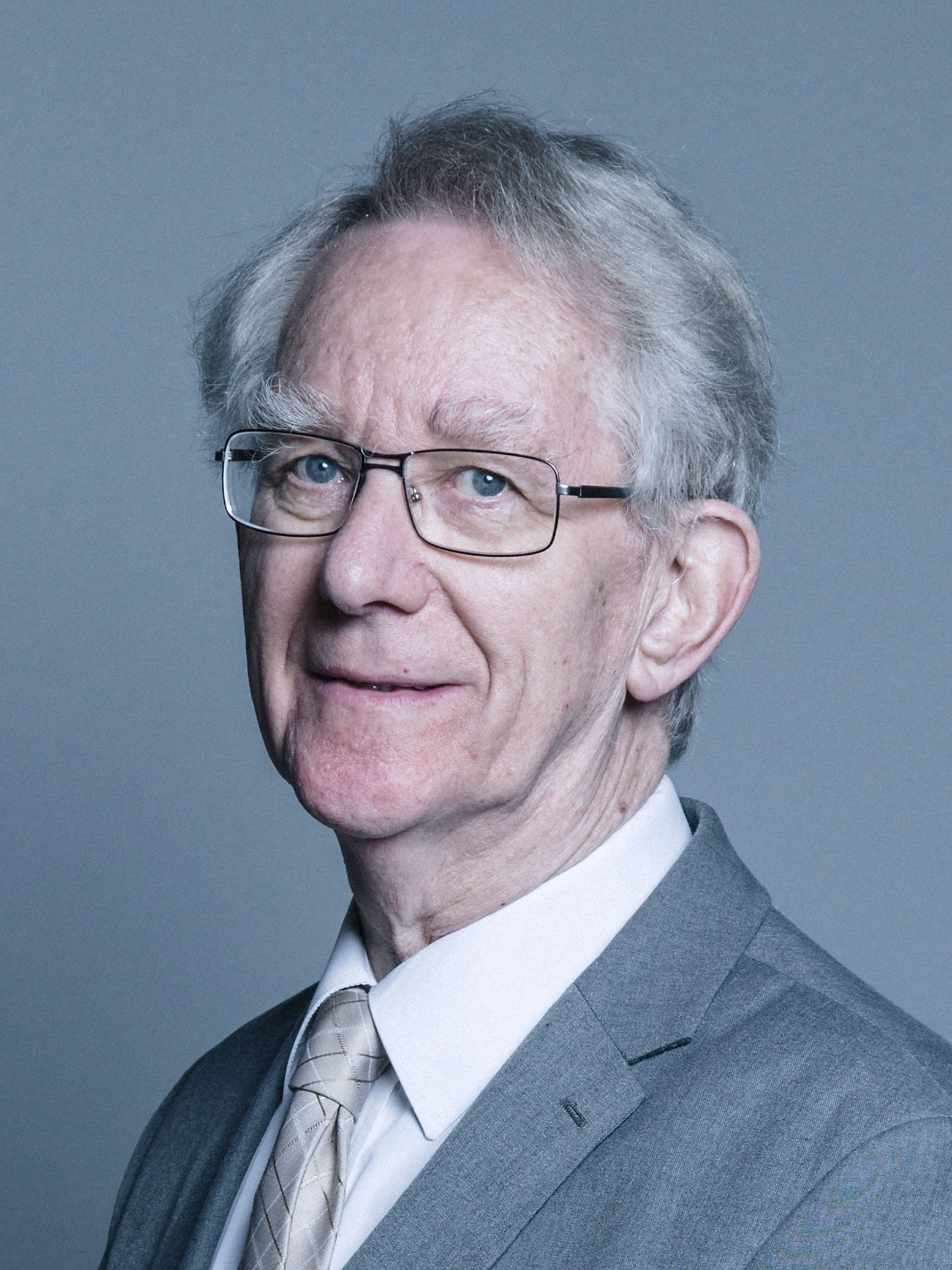
Andrew Stunell combined a commitment to Liberal values with a highly practical negotiating skill. He initially came into Liberal politics through a single issue: the Harold Wilson government reneging on its guarantee to the Kenyan Asians to admit them to Britain if the post-independence Kenyatta government expelled them. When, in 1968, their expulsion happened, the Labour government passed a new Commonwealth Immigrants Act to restrict drastically their entry to the UK. Though from a family that frowned on political activism, the ground for his political response was prepared by his non-conformist commitment to his local Baptist church which had already led to him being involved in international development projects. Like others who joined the Liberal party on a single issue of principle, Stunell found the party a congenial home, well suited to his personality.
Stunell always saw his aptitude as being in the practical application of his beliefs rather than the intellectual development of philosophy and policy. That practicality was evident even from his choice of architecture as his university courses and, when he had a professional post in Runcorn New Town Development Corporation, he was active in his trade union, NALGO, and spent four years as staff side representative negotiating on the Whitley Council for New Towns. Living at the time in Chester he was elected to the city council in 1979, serving there for eleven years, and to the Cheshire county council from 1981 to 1991. On the latter he immediately became the Liberal Alliance group leader and was thrust into the difficult practicalities of a hung council. Typically Stunell, having concluded a modus operandi for Liberal Alliance involvement in the governance of the council, enshrined this in a document which became known as the “Cheshire Convention”. It was subsequently used as the model for ensuring the effective administration of councils with no single party control.
Stunell contested his local Chester parliamentary constituency three times , in 1979, 1983 and 1987. It was an uphill task, not least being a Labour/Conservative marginal, but he increased the Liberal Alliance vote on each occasion - in 1987 against the national trend. In 1989 he was persuaded to put his name forward for the candidature in the Hazel Grove constituency, just twenty miles from Chester. This was much more promising Liberal/Conservative marginal and had been held briefly between the two 1974 elections by the charismatic GP, Michael Winstanley. Stunell was duly adopted and at the 1992 election slightly increased the party vote - again against the national trend - but failed to gain the seat by just 929 votes. He then committed himself fully to the constituency, moving there from Chester with his family. He had given up his architectural practice in 1985 to work full time for the Association of Liberal Democrat Councillors and this gave him rather more freedom for politics. Knowing well the electoral advantage of a presence on the local council, in 1994 he fought and won a seat on the Stockport Metropolitan Borough Council. At the 1997 parliamentary election Stunell gained the Hazel Grove seat with an almost 12,000 majority and a swing way ahead of the party’s national performance. It was the culmination of eight years careful planned campaigning; and significantly by the time of the 1997 election Liberal Democrats held every seat in the Hazel Grove constituency on the Stockport Council. Like many Liberals, Stunell had sacrificed financial advancement in order to concentrate on his politics and, as a consequence, he was astounded at what he regarded was a high MP’s salary. Typically he had never bothered to find out the pay and, when he was informed of the amount, he called his wife, Gillian, and said to her “we’re rich!”Similarly, never having taken himself too seriously, he happily involved himself in the practical tasks at his local Methodist church.
Immediately following the 1987 general election, at which the two Alliance parties had dropped back compared with 1983, albeit only slightly1, David Steel bounced the parties into moving towards merger and at the Harrogate Liberal Assembly in September that year delegates recognised his negotiating experience in local government and appointed Stunell (and also myself) to the eight members directly elected to the negotiating team.2 His first action was to draft a paper for the first meeting of the Liberal team. This set out the “issues that must be settled by the team prior to substantive talks with the SDP” (Stunell emphasis). The paper went on to set out many of the pitfalls ahead “into which the team subsequently fell”; he also called for an analysis of the weaknesses and strengths on both sides, “Unfortunately this never took place”. 3 Later in the negotiations, when members of the team were speculating on whether amendments to the final documents should be debated if the [Liberal] Assembly did not vote for merger, Stunell was decisive stating that the Assembly was sovereign and that “merger needs the Assembly’s massive support”.4 Throughout the negotiations Stunell was unflappable and played a significant role, even though at one point he alarmed colleagues by stating that he was less concerned about the aims of merger than the processes of negotiation.
Immediately on Stunell’s election the then party leader, Paddy Ashdown, aware of his particular skill made him Deputy Whip. It is clear that Ashdown had a high regard for Stunell’s loyalty and for his ability to defuse internal dissent and that he would act professionally even when he personally disagreed with the line being promoted.5 Ashdown’s successor, Charles Kennedy promoted Stunell to Chief Whip in 2001 and he continued in that post until the end of Kenney’s leadership in 2006. Under his stewardship as Chief Whip every Liberal Democrat voted against the March 2003 invasion of Iraq - the only party to do so unanimously - even before the absence of the assumed weapons of mass destruction became apparent. A year later he headed the Private Members’ ballot and successfully steered through the Commons an act designed to make new buildings greener and safer. Stunell was also concerned at the way new MPs were expected to cope in a complex procedural and political environment and was instrumental in getting induction courses set up for later intakes. As Chief Whip Stunell was “hiding a disturbing secret: the Leader [Charles Kennedy] was drinking heavily and it was beginning to affect his performance. [The party] made it through without it becoming public, but the whispers grew louder, and eventually Mr Kennedy was ousted in a putsch by the party’s MPs.” Stunell admitted that “behind the scenes things were difficutl.”6 For over four years, during almost the whole of Stunell’s period as Chief Whip, the problem of Kennedy’s alcoholism had hovered over the party’s fortunes and required considerable smounts of his time trying to resolve internal tensions not least to hide the situation from the media. Inevitably there were those who felt he had “failed to grasp the scale of their anxieties.”7 By December 2005 Stunell could not have been unaware of the inevitable outcome of Kennedy’s ill health having received a “devastating aide-memoir” fro Chris Rennard, the party’s Chief Executive, setting out that Kennedy’s position was untenable.8
As is invariably the case with smaller parliamentary parties, Liberal Democrat Members have to take on subject responsibilities and Stunell was spokesman on Energy (1997-2006) which tied in well with his architectural qualifications and experience, and on Communities and Local Government (2006-08). He was also Chair of the local election campaign team, 2008, and vice-chair of the general election campaign team, (2009-10). In late 2009, some six months before the anticipated date of the general election, the Liberal Democrat leader, Nick Clegg, set up a highly confidential internal group to prepare for the eventuality of the party having the balance of power. In addition to Stunell, its members were Danny Alexander, Chris Huhne and David Laws.9 Stunell welcomed this initiative particularly as he was critical of the Liberals’ involvement in the Lib-Lab pact of 1977-78, stating: “as someone who had been on the outside at that point, all my experience in local government showed that the Liberals had completely misplayed their hand in that Lib-Lab pact.”10 By preparing in advance in early 2010 they were able to establish what type of inter-party co-operation was vital and what should be the party’s priorities therein.11 It was clear that Stunell was not only regarded as having negotiating experience in the local government sphere but also could play the role as a trusted link between the parliamentary party and the party in the country. There were inevitably great pressures on the party leadership, including Stunell as Chief Whip, to make the key decision on coalition, not least because the financial markets were very febrile, but Stunell counselled caution. Speaking on the Sunday afternoon, after just four days of intensive sessions with the Liberal Democrat parliamentary party and party officials and with both Labour and Conservative parties: “we are all very tired. We need to take a deep breath and get this right. And we need to realise that from a public and media perspective there is a real, real difficulty legitimising Labour after they have lost the election so badly.”12
In the negotiations with the Labour team it was Stunell who kept stressing the importance of constitutional reform, for instance proposing setting up a new Commons committee to undertake the time tabling of government business. 13 At the next meeting with Labour Stunell is reported as asking “bluntly” how serious Labour was about delivering its negotiation commitments and “what guarantees it could give.14 Then, being described as a “wiry persistent man, he had irritated Peter [Mandelson] with his aggressive pointmaking and minilecture on the elective dictatorship” all of which provoked Mandelson to ask his colleagues, “Who is he?” Andrew Adonis had to inform Mandelson that Stunell was an ex-local government leader and had a reputation as the Lib Dem expert in coalition-mongering in hung local authorities.”15 Stunell was certainly persistent in the discussions with Labour, telling a later meeting that they needed to “get real” and to “raise your offer considerably if [they] wanted to ‘stay in the game’”. This again annoyed Peter Mandelson who texted Danny Alexander during the meeting, asking whether Andrew “might be a bit more civil so we could make progress”!16
He later commented on the negotiations:
“It wasn’t at all clear it would always be the Conservatives. The arithmetic was a real tease because if you added us and Labour together we would not have had an overall majority and therefore would have required either the active or passive support of another party. We had a discussion with the Labour Party in which we did point this out to them. They were very gung ho about us joining them, but I think they thought what they could get was a Lib-Lab pact, like it had been in 1978, where basically the Liberals simply went along with Labour in the Callaghan government.17
“When we said ‘The numbers don’t add up,’ they said ....’Don’t worry, we’ve got the nationalists’. Had any other basis for a deal been there then we might have explored what they meant by ‘We’ve got the nationalist.’”18
By contrast Stunell found the Conservatives “were falling over themselves to give the Liberal Democrats what they wanted. ... It would have been a pretty odd situation to have then turned away and said that’s not good enough.”19
He was immediately appointed as Under-Secretary in the Department of Communities and Local Government in which ministerial capacity he was responsible for what became the 2011 Localism Act which devolved a number of powers from central to local government. However, after just two years in post he was a victim of a reshuffle in July 2012, along with Sarah Teather, Nick Harvey and Paul Burstow. The reason given by Nick Clegg was that he wanted to give other deserving Liberal democrat MPs “a place in the sun” before the end of this parliament. In fact it was also to enable David Laws to return to government as Minister of State for Schools and also the Cabinet Office.20
Stunell was awarded the OBE in 1995 for political service and was knighted in 2013. He was made a member of the Privy Council in 2012. He was created a Life Peer in 2015 following his retirement from the House of Commons. In the Lords he served on the Committee on Standards in Public Life, 2016-2022. As the party’s spokesman in the Lords on the Construction Industry, he accepted an invitation by Lord Newby, the party leader, to review the impact of Brexit on the construction industry.
Robert Andrew Stunell, Lord Stunell, born 24 November 1942; died 29 April 2024
References
1. Liberal party down by 1% and the SDP down by 2%.
2. Details of all matters relating to the inter-party negotiations regarding the merger between the Liberal and the Social Democratic parties are to be found in Merger - The Inside Story, Rachael Pitchford and Tony Greaves, Liberal Renewal, 1989.
3. Op cit pp 16/17.
4. Op cit pp 138/139.
5. See eg Ashdown Diaries, Volume II, Allen Lane Penguin Press, 2001, entry for 22 July, p 70; also entries for 22 October 1998, p 303; and for 10 November 1998, p 330.
6. Article, Rosa Prince, 25 April 2015, Daily Telegraph.
7. Charles Kennedy - A Tragic Flaw, Greg Hurst, Politicos 2006, pp 189 and 252; Hurst’s book is the source of much of the material on this period.
8. Hurst op cit, appendix E.
9. Politics Between the Extremes, Nick Clegg, The Bodley Head, 2016, p 175; Nick Clegg - The Biography, Chris Bowers, Biteback, 2011, p 223; 22 Days in May - The Birth of the Lib Dem - Conservative Coalition, David Laws, Biteback 2010, pp 14 et seq.
10. Op cit Daily Telegraph article.
11. David Laws’ 22 Days in May is important on this subject, pp 15-22.
12. Coalition, David Laws, Biteback 2016, pp 12-13.
13. 5 Days in May - The Coalition and Beyond, Andrew Adonis, Biteback, 2013, p 47
14. Adonis op cit, p 49.
15. Adonis op cit, p 50.
16. Adonis op cit, p 115.
17. For this period see: The Lib-Lab Pact - A Parliamentary Agreement, 1977-78, Jonathan Kirkup, Palgrave MacMillan, 2016; A House Divided - The Lib-Lab Pact and the Future of British Politics, David Steel, 1980; The Pact - The Inside Story of the Lib-Lab Government, 1977-78, Alastair Michie and Simon Hoggart, Quartet, 1978.
18. Daily Telegraph 2015 interview op cit. In fact Douglas Alexander stated publicly at the time that “Under no circumstances will we work with the SNP”.
19. Daily Telegraph, 2015, op cit.
20. Daily Telegraph, 2015, op cit.
Lord Andrew Stunell
For six months before the general election of 2010, Andrew Stunell, who has died aged 81, was among the Liberal Democrat MPs preparing for a possible hung parliament. When that result eventuated he was appointed by the party’s leader, Nick Clegg, to its team negotiating for a coalition, together with David Laws, Danny Alexander and Chris Huhne.
His approach was coloured by the 1977-78 Lib-Lab pact that sustained James Callaghan’s Labour government, when he felt that the Liberals misplayed their hand and failed to achieve benefits for the party. On the Sunday after the 2010 polling day, after two days of almost incessant discussion and debate, Stunell cautioned his colleagues against rushing the negotiations, with the “real, real difficulties in legitimising Labour after they have lost so badly”. From his trade union experience witn NALGO in the 1970s, he expected Labour “to have some really feisty negotiators” but “they just didn’t have anything. They were not there at all. When we said ‘the numbers don’t add up’, they said, ‘Don’t worry, we’ve got the nationalists.’” On the other hand he was “surprised that the Conservatives were prepared to come as far as they did in the negotiations”.
As the leader of the Liberal Democrat group on Cheshire County council (1981-91) he had developed a widely accepted guide for party colleagues on councils with no overall party control. In 1988 he was a member of the Liberals’ negotiating team on the merger with the SDP that resulted in the emergence of the Liberal Democrats – though he alarmed colleagues by commenting that he enjoyed the process more than the end result.
In the Conservative-Lib Dem coalition government that resulted in 2010, he was appointed parliamentary under-secretary in the Department for Communities and Local Government, but after only two years was reshuffled out, together with three other Liberal Democrat ministers. While at the department he helped to steer through the Localism Act, which devolved a number of powers from central to local government.
Born in Sutton, Surrey, Andrew was one of four sons of Trixie, who had been a Civil Service clerk, and Robert Stunell, a mechanical engineer. From Surbiton grammar he went to Manchester University and Liverpool Polytechnic to study architecture. Then came architectural posts with the Co-operative Wholesale Society in Manchester (1965-67) and the Runcorn New Town Development Corporation (1967-81).
As a Baptist lay preacher he had a keen sense of social justice, and in 1968 he was appalled when Harold Wilson’s Labour government reneged on its promise to Kenyan Asians to have the right to come to Britain if Jomo Kenyatta’s government pressured them. Only the Liberal party opposed the government, and Stunell joined it.
He was on Chester city council (1979-90) in addition to his decade on the county council. From 1985 he was employed by the Association of Liberal Councillors, applying his experience nationally. Stunell fought his local Chester seat at the three general elections, 1979, 1983 and 1987, won by Margaret Thatcher as Conservative leader. It was a Labour/Conservative marginal and he struggled to poll a respectable third place vote. For the 1992 election, he was invited to put his name forward for the Liberal Alliance for the Hazel Grove seat in Greater Manchester, and reduced the Conservative majority to 929.
The Stunell family then moved into the constituency before the 1992 election; at the municipal election that followed he gained a seat from Labour on the local Stockport council. In the 1997 general election he was elected with a majority of almost 12,000. Liberal Democrat MPs more than doubled to 46, and Stunell’s local government experience was invaluable as deputy chief whip and then chief whip (2001-06). Under his stewardship every Liberal Democrat MP voted against invasion of Iraq.
Heading the private members’ ballot enabled him to introduce the Sustainable and Secure Buildings Act 2004, intended to make new buildings greener and safer. Stunell was also concerned at the way new MPs were expected to cope in a complex procedural and political environment, and was instrumental in getting induction courses set up for later intakes.
When he became an MP, he was pleasantly surprised at the size of the salary, having never previously looked it up, and he happily involved himself in the practical tasks at his local Methodist church, having switched from his former Baptist affiliation whilst in Chester. His interests included third world issues and astronomy. He was made OBE in 1995 and knighted in 2013. After leaving the Commons at the 2015 election he entered the Lords, and served on the Committee on Standards in Public Life (2016-22).
In 1967 he married Gillian Chorley, a music teacher who carried on her career. She survives him, along with their five children, Judith, Kari, Peter, Mark and Daniel, six grandchildren, and his brothers, John, Peter and Philip.
Robert Andrew Stunell, Lord Stunell, born 24 November 1942; died 29 April 2024
Michael Steed - an appreciation
 Michael Steed was the epitome of intellectual rigour; this, coupled with a remarkable memory for detail, made him a formidable politician. Fortunately for Liberalism he realised: ‘in my late teens that liberalism, not socialism, must be at the core of a worthwhile and effective radical party’[1] and he never wavered from that view. Michael had three particular strands to his politics, first was his active commitment to the promotion of his Liberal values, particularly international Liberalism, second, and more academic, was the development of psephology - the study of electoral processes - in which he was acknowledged to be one of the leading specialists; and third was a deep interest in Liberal history. Two of his specific campaigns were for gay rights and for European integration, but it was his awareness of the instinctive Liberal understanding of the human personality and its need for freedom, coupled with a deep distaste for Tory imperialism, the aggressiveness of the Tory right, and an awareness that on the issue of European integration, ‘Labour was easily the most reactionary and protectionist party’, that confirmed his commitment to Liberalism.[2]
Born on 25th January 1940 into a nominally Conservative family he discovered his political affinity for himself rather than inheriting it and somewhat precociously, and bravely, he derived his initial appreciation of liberalism by reading John Morley’s two volume biography of Gladstone. Even more precociously he re-founded the local Liberal association whilst still at school. Happily this coincided with Jo Grimond becoming the Liberal party leader and Steed found Grimond’s brand of left radicalism congenial. He admitted to going through a brief socialist phase ‘ as part of growing up but became convinced that liberalism had to be at the heart of progressive and radical politics .[3]
He won a scholarship to Corpus Christi College, Cambridge, and began by reading economics but switched to geography, which was particularly apposite for his later analyses of voting trends. It was whilst that he got involved in national politics having found himself on a delegation to a seminar run by the World Federation of Liberal and Radical Youth. In the time-honoured way of Liberal Party politics this quickly led to him becoming the national chair of the Union of Liberal Students with an ex-officio seat on the party’s National Executive and on the Liberal Party Council. He rapidly became involved in the radical causes that remained with him - and the Liberal party - thereafter: constitutional reform, European federalism, regional devolution, electoral reform, homosexual equality and anti-apartheid. It was whilst trying to deliver aid to the victims of the 1960 Sharpeville massacre that he was refused entry into South Africa by the regime.
Steed was an officer of the National League of Young Liberals during much of the rise of the radical Young Liberal movement - nicknamed the Red Guard by sections of the press - but he avoided the radical action that enveloped the party in public controversy. His contribution to a Liberal Democrat History Group meeting on this period gave no hint of any personal involvment with the Young Liberals involvement in direct action, often in conjunction with other left groups, over the Vietnam war, South African apartheid and Rhodesia’s white government’s Unilateral Declaration of Independence, plus arguing for UK withdrawal from NATO and other targets of a newly radicalised youth culture. [4] On the other side those broadly defined as the party establishment were outraged at what they saw as vote losing actions at odds with party policy and the parliamentary process. The highly public divisions within the party came to a head at the 1965 Liberal Assembly in Scarborough and dragged on thereafter until, in December 1970, following the disastrous results at that year’s general election, the party leader, Jeremy Thorpe, set up a committee under the chairmanship of Stephen Terrell QC, the party’s candidate in Eastbourne, to examine the existing relations between the Young Liberal movement and other sections of the Liberal party, to take evidence and to make recommendations. Its report’s main recommendation was that membership of the party should only be through a constituency party.[5] One of Steed’s criticisms of the report was that it was addressed to the party leader, Jeremy Thorpe, rather than to the party. He made a similar point in a speech at the time, saying that the party must shift attention away from personalities to a wide-ranging debate about ideology, principles and policies. [6]
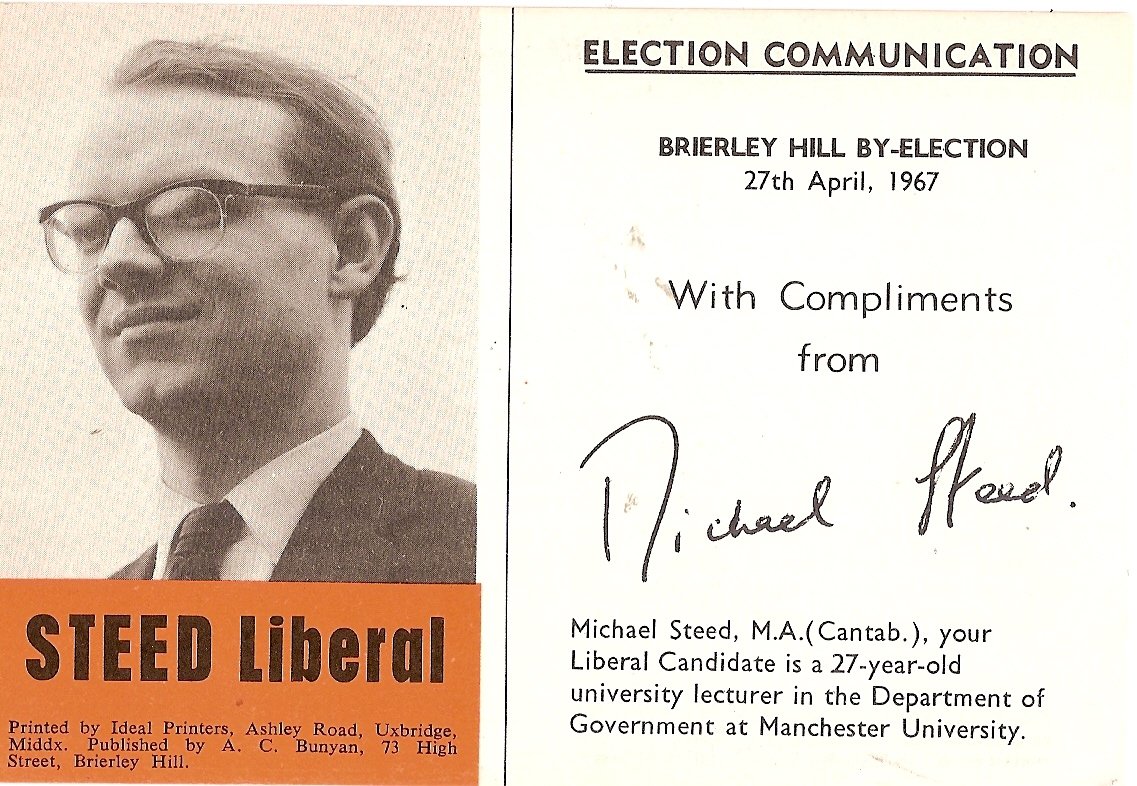 Even though Michael Steed was the Chair of the University Liberal Students during much of this time he was conspicuously absent from what were seen as its excesses and did not contribute to either of the two seminal Young Liberal publications of the period.[7] In essence he was in the movement but not of it. With his more academic and analytical mind, and being somewhat older than the key leaders of the movement, the party’s slightly scurrilous magazine, Radical Bulletin,[8] dubbed him the venerable Steed . He commented on the period at a Liberal Democrat History Group seminar in 2010.[9] However, when the Young Liberals were determined to test their policies and tactics out with the electorate, and were the prime movers of the party contesting the Brierley Hill by-election on 24 April 1967, Steed was the obvious choice as candidate. It was a quixotic campaign in a constituency that had not been fought by Liberals since 1950 and which, in fact, was not contested in the following 1970 election. He polled just 7.8% and forfeited his deposit.
During this period he had been a student of David Butler at Nuffield College, Oxford, but his rapidly increasing commitment to psephological research and analysis led him to abandon his PhD. In 1966 he went from Nuffield to Manchester University as a Lecturer in Government, a post he held until 1987, taking early retirement through ill health. Alongside his commitment to the Liberal party he developed a reputation as an expert and independent commentator on election results. He contributed the statistical analysis to the definitive Nuffield Study on each general election from 1970 to 2005, latterly with John Curtice. He also provided the annual analysis of local elections in The Economist from 1968 to 1991. Steed developed an encyclopaedic knowledge of even the smallest local council election and Vernon Bogdanor recounted that as a graduate student at Nuffield, studying local elections, he (Steed) would scan local newspapaers at breakfast. One morning he exclaimed loudly, “Good heavens!” We asked what disaster had occurred. He replied that an independent had won a local by-election at Newbury and that this had not happened since 1905"![10]
In the course of analysing results he developed a more sophisticated method for calculating the swing between competing parties than that hitherto used by David Butler. The Steed Swing, he argued, coped better with three-party politics than Butler Swing . He also had a deep awareness of electoral geography and, with John Curtice, was able to show that regional identities, coupled with historical influences, differentially affected the national outcomes.
Steed continued to contest elections and he was the Liberal candidate in the more promising Truro constituency at the 1970 general election but finished third. In 1973 he contested the Manchester Exchange by-election, a previously solid Labour seat with little Liberal activity. Steed polled 36.3% and came a creditable second, the Liberals constructing a community politics campaign from scratch, particularly concentrating on soliciting and dealing with electors’ individual problems - a tactic that the successful Labour candidate memorably labelled ‘instant compassion’. He then unsuccessfully fought Manchester Central in the February 1974 general election and Burnley in 1983. He also fought Greater Manchester North at the 1979 European parliament election.
Steed’s difficulty as a parliamentary candidate was not uncommon among academics fighting elections in that his warm personality was at times clouded behind his intellectualism. A very different side to Steed’s personality was in his bravura singing performances at the party’s Glee Club on the last evening of the annual party conference. He also contributed a number of skilful parodies and alternative words to old tunes, many of which are enshrined in the Liberator Songbook.[11]
Steed was a prolific pamphleteer and the contributor of chapters to numerous books but never produced a major book under his own name. It may well have been, similar to his abandonment of his PhD thesis, that confining himself over a long period to a single subject bored him and he preferred to absorb and to utilise a wide range of knowledge.[12] Equally eclectic was his support for a wide range of activism, from international campaigns to regional and local projects. His internationalism, his wide knowledge of European politics and his particular passion for French politics, led him to write a booklet, ‘Who’s a Liberal in Europe?’[13] This was followed by the chapter, ‘The Liberal parties in Italy, France, Germany and the United Kingdom’ in a 1982 book,[14] and also, in 1988 a chapter, jointly with Patrick Humphrey, ‘Identifying Liberal parties’ in 1988.[15] Steed also took a leading role in the updating of the preamble to the Liberal Party Constitution in 1969. In 1976 he devised the system for electing the leader of the Liberal Party by the party membership rather than only by the MPs. In 1978 Steed was elected as President of the party, defeating Christopher Mayhew, a former Labour MP and a recent convert to the Liberal Party.
In 1970 he married Margareta Holmstedt, a Swedish Liberal who was a lecturer at Bradford University. They set up home in Todmorden the Pennine textile town on the border with Lancashire and thus roughly halfway between their two universities. Whilst living there he was elected to Todmorden Town Council serving from 1987 to 1991. They eventually drifted apart, separating in 1990 and divorcing in 2004. Margareta continued on the council and become its mayor 2010-11.
In 1982 I benefited personally from Steed’s electoral knowledge and his forensic skills. The Boundary Commission’s recommendations for Leeds had produced an unwinnable home constituency which partnered two strong Liberal wards with two very different wards which, though contiguous on the map, had only become part of Leeds at the local government reorganisation of 1974. The problem for the reviewers was that Leeds had eight constituencies but thirty-three wards. Understandably the Boundary Commission sought to combine five of the smaller wards in to a constituency as opposed to communities of interest. The Leeds Liberals made a submission opposing the proposals and Steed came to Leeds to present the case before the Inspector. He was formidable with a vast knowledge of the law and of precedents. In particular he pointed out that it was not obligatory to constrict all the wards within one local authority and that the Tyne Bridge constituency in the north-east bridged two local authorities. He therefore proposed that the outlying ward of Rothwell on the southern edge of Leeds could be included in a Wakefield constituency. The Commission was persuaded by him and the revised proposals produced the Leeds West constituency which the Liberal Party duly won in 1983. In 1983 Steed contributed the chapter on ‘The Electoral Strategy of the Liberal Party’ to a book on many aspects of the party.[16]
The Alliance with the SDP from 1981 and the merger with that party in 1988 put Steed at odds with many of his Social Liberal colleagues. Whereas most of those colleagues opposed the links with the SDP, he took a different view and though he had reservations, he wrote:
I was one of those who did not find the actual transition from Liberal Party to Liberal Democrats easy; the merger process was made avoidably painful. But as a Grimondite Liberal, I never had any doubt as to the principle of merger with the SDP. I am a Liberal Democrat today in the hope of some further realignment.[17]
In 1996 Steed contributed a chapter on ‘The Liberal Tradition’ to a book of essays. In the course of just twenty pages he sets out a brilliant and succinct essay on the essence of Liberalism.[18]
In 1987 Steed he began to suffer a devastating neurological condition the physical effects of which severely curtailed his activities. The condition proved difficult to diagnose accurately. The illness ebbed and flowed and at times it seemed as if it would be imminently terminal. His mental faculties were unaffected and he remained as effective as ever and, In fact, he continued with many writing and speaking engagements, even though he was for many years confined to a wheelchair. He was commenting on Liberal history matters up to a matter of days before his death. Following his forced retirement from his Manchester lectureship, and finding it increasingly difficult to cope with steep hills of the Todmorden area, he returned to his native Kent and became active with the Canterbury Liberal Democrats. He was elected to the Canterbury City Council for a single term in 2008.
In 1999 he met Barry Clements, a master carpenter, at a men’s social meeting in Whitstable and they became long term partners and were formally joined in a civil partnership in 2023. With Barry’s solid and constant help they were able to spend time most years in the South of France. Barry survives him, as do his four sisters and his brother to all of whom he was very close. He died on 3 September 2023.
References
1. Why I am a Liberal Democrat, ed Duncan Brack, Liberal Democrat Publications, 1996.
4. Red Guard versus Old Guard? The influence of the Young Liberal movement on the Liberal Party in the 1960s and 1970s, Report by Graham Lippiatt on a Liberal Democrat History Group meeting on 12 March 2012. Journal of Liberal History 68, Autumn 2010.
5. Report of the Liberal Commission to the Right Honourable Jeremy Thorpe MP (Chair Stephen Terrell QC), 1st July 1971.
6. The Guardian, 15 September 1969.
7. Blackpool Essays - towards a radical view of society, ed Tony Greaves, Gunfire Publications for the National League of Young Liberals, 1967, and Scarborough Perspectives, ed Bernard Greaves, National League of Young Liberals, 1971.
8. Radical Bulletin is still published as an insert within the fifty year plus long running magazine Liberator.
9. Journal of Liberal History 68, Autumn 2010.
10. Obituary, The Times, 16 September 2023.
11. Liberator Songbook, editions 1 to 25, Liberator Magazine, https://liberatormagazine.org.uk/
12. For a list of Steed s publications, see his Wikipedia entry, (accessed 3 January 2024); A list of his contributions to the Journal of Liberal History can be accessed via the Journal s website: https://liberalhistory.org.uk/people/michael-steed/
13. North West Community Newspapers, Manchester, 1975.
14. Moderates and Conservatives in Western Europe, ed R Morgan and S Silvestri, Heinemann Education, 1982.
15. Liberal Parties in Western Europe, ed Emil J Kirchener, Cambridge University Press 1988.
16. Liberal Party Politics, ed Vernon Bogdanor, Clarendon Press, Oxford, 1983.
17. Why I am a Liberal Democrat, ed Duncan Brack, Liberal Democrat Publications 1996.
18. The Liberal Democrats, ed D N MacIver, Prentice Hall/Wheatsheaf, 1996.
Recently added...
-
Menzies (Ming) Campbell
23 December 2025
 by Michael Meadowcroft Before politics Ming Campbell had successful...
 -
23 December 2025
Annette Brooke -
23 December 2025
Joiners and Leavers -
25 October 2023
Cause and Effect - the background to Hamas terrorism
